

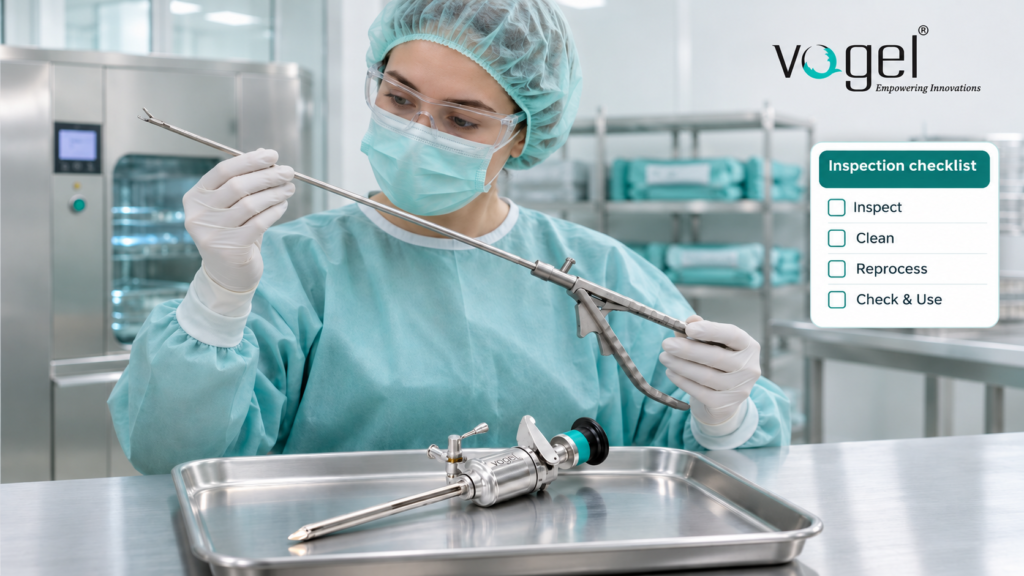
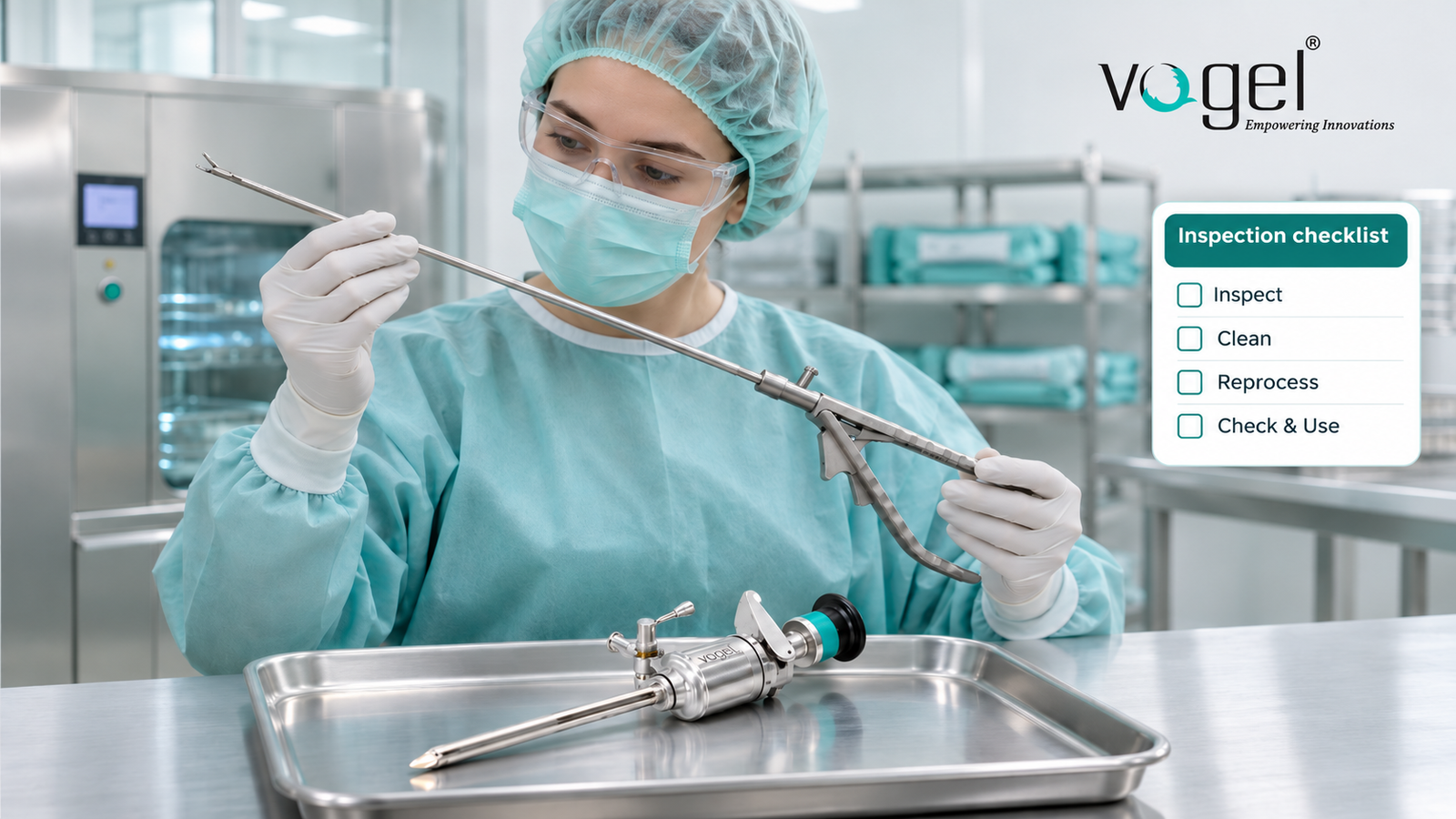
A device may appear clean and still need further processing or inspection. Appropriate trained teams must follow the current, device-specific validated IFU.
Official VOGEL product photographs
These are unaltered product photographs from the VOGEL website. They illustrate different instrument patterns, not their clinical suitability, compatibility or dimensions. Refer to the exact device documentation before purchase or reuse.

VOGEL Maryland Dissector
Original VOGEL dissector image; no processing technique shown.
Explore VOGEL instrument information ↗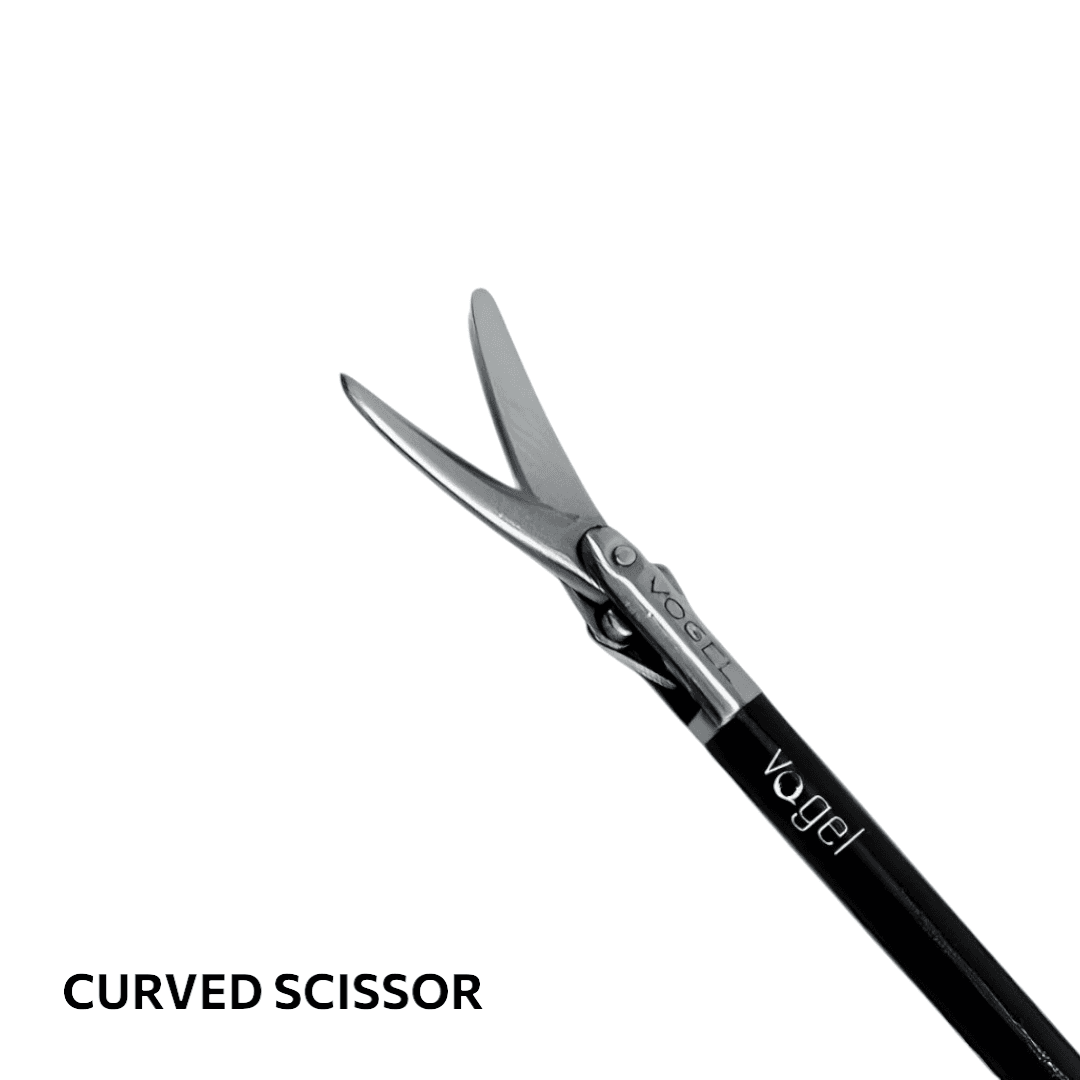
VOGEL Curved Scissor
Original VOGEL scissor image; model-specific reprocessing IFU required.
Explore VOGEL instrument information ↗A reusable laparoscopic instrument may look clean and still be unsuitable for the next case. A damaged seal, difficult-to-clean joint, misaligned jaw or compromised insulation can be easy to miss in a busy workflow. That is why hospitals need more than a general “wash and sterilize” instruction: they need product-specific reprocessing procedures and a reliable inspection process.
This article offers a reusable laparoscopic instruments inspection checklist for trained sterile processing, OT and biomedical teams. It is an organizational guide, not a substitute for the device manufacturer’s validated instructions for use (IFU), hospital policy or qualified infection prevention guidance.
Why inspection belongs in the reprocessing workflow
Long, slender shafts, joints, ratchets, lumens and detachable components make minimally invasive instruments different from many basic handheld tools. Dirt or damage can remain in less-visible areas. Reusable devices also vary in material, design and allowable cleaning methods, so a uniform shortcut can be unsafe.
The FDA describes a broad three-stage reprocessing sequence: point-of-use measures, thorough cleaning and an appropriate disinfection or sterilization step. The exact procedure is specific to the device. The CDC emphasizes that surgical instruments entering sterile tissue require sterilization before use, and that cleaning must precede sterilization.
Step 1: Identify the instrument and retrieve its IFU
Before processing a new model, confirm its product identification, reusable status, detachable components and correct manufacturer instructions. Check whether the IFU requires disassembly, particular brushes or connections, or limitations on cleaning chemicals, temperature or machinery. Do not apply one manufacturer’s sterilization cycle to another product simply because the two look similar.
For mixed hospital inventories, use a system to associate IFUs with the actual SKU. A photograph or descriptive label alone may not be a sufficient identifier.
Step 2: Take appropriate point-of-use measures
The goal at point of use is to prevent soil from becoming harder to remove and to support safe transfer to the dedicated processing area. Follow local policy and the applicable device IFU for initial treatment and handling. Avoid leaving used items exposed in a way that allows deposits to dry; use approved containment and transport processes.
These precautions are not a replacement for subsequent cleaning. They are the first part of the process.
Step 3: Clean thoroughly using the validated method
Cleaning must remove soil from all applicable surfaces, including difficult-to-reach parts. Follow the manufacturer’s prescribed sequence for disassembly, brushing, flushing or automated equipment where applicable. Confirm detergent and equipment compatibility. Complex joints and internal passages deserve special attention because surface appearance does not prove internal cleanliness.
The CDC recommends cleaning before disinfection or sterilization and inspecting equipment for damage that prevents effective processing. Where validation requires a particular test or inspection method, use that method; don’t substitute guesswork or a visual check alone.
Step 4: Inspect after cleaning and before final processing
A repeatable inspection record helps staff notice deterioration early. The checks below are examples to be adapted to each instrument’s IFU and clinical use.
| Area to examine | What to look for | If there is a problem |
|---|---|---|
| Jaw and working end | Visible debris, corrosion, distortion, incorrect alignment | Remove from service; assess per facility procedure |
| Hinges, joints and ratchets | Restricted movement, inconsistent engagement, visible wear | Escalate for qualified evaluation |
| Shaft and exterior | Damage, cracks, pitting, deformation or trapped debris | Do not release until resolved under policy |
| Insulation, if fitted | Visible cuts, abrasion or other faults; required test result | Follow manufacturer testing and removal criteria |
| Detachable parts and seals | Missing pieces, damage, incorrect reassembly | Verify the correct components and assembly instructions |
| Identification | Missing or unreadable item/lot/serial ID where required | Hold for identification and traceability resolution |
A passing visual check does not guarantee electrical insulation integrity or device performance. Use any test instruments or specialized checks required by the manufacturer and institutional policy. Never attempt to “repair” damaged insulating surfaces using improvised methods.
Step 5: Reassemble, package, sterilize and document
After required checks, follow the IFU for reassembly, packaging, load configuration and the validated sterilization method appropriate to the instrument. Hospital sterilization processes must follow instrument, sterilizer and packaging manufacturer instructions. Personnel should record the required cycle, monitoring and release information under institutional policy.
Do not use a generic internet temperature/time setting as a sterilization recipe. Such parameters depend on the exact device, the validated method, packaging and equipment. The CDC explicitly directs facilities to use appropriate manufacturer-recommended operating parameters.
When an instrument should be held out of service
An item should be quarantined or escalated when there is unexplained residue, visible damage, missing parts, failed function or an inability to follow its IFU. The appropriate disposition may be further evaluation, qualified servicing, replacement or disposal, depending on the product and applicable rules.
A repair should not simply restore appearance. Confirm that any repaired device meets the manufacturer’s and facility’s release criteria, including any required retesting and reprocessing before use.
Make your inventory easier to reprocess
Procurement and CSSD teams can prevent problems at the buying stage. Before a reusable model is added to inventory, request:
- The correct IFU and any necessary diagrams or component lists.
- The allowable cleaning agents, equipment and processing method.
- Any special cleaning accessories or connectors required.
- Replacement part and service arrangements.
- Relevant identification and traceability information.
- The staff training needed to process the device consistently.
For facilities building new laparoscopic sets, discuss reprocessing feasibility alongside clinical preference and purchase price. The VOGEL laparoscopy portfolio provides an overview of several instrument classes; request item-specific reprocessing documentation before adopting any model.
A short checklist for the team handover
At every handover, staff should be able to answer: What is the device? Which instructions apply? Has it been cleaned correctly? What inspection was completed? Was anything held out of service? What evidence supports release? Having clear answers can reduce ambiguity between the OT, CSSD, biomedical and procurement teams.
Final takeaway
Reusable instruments can be valuable assets only when their safe handling and processing are achievable in the facility. Treat the IFU as the governing document, support staff with appropriate training, and turn inspection findings into a documented maintenance or replacement process.
If your hospital is planning a reusable laparoscopic inventory, explore the VOGEL instrument categories and ask for device-specific documentation, servicing options and an itemized quotation before placing an order.
Required checks before an instrument returns to service
A trained processing team should verify that the item matches its identification and current IFU, has completed the required validated cleaning and sterilization pathway, and meets the facility’s inspection, packaging and release criteria. Where required by the IFU or facility policy, inspection may include articulation, detachable components, alignment, sharp edges, insulation and functional checks using appropriate validated methods. A visually clean exterior alone is insufficient evidence of cleanliness in inaccessible areas.
If a check fails: Segregate the item, record the defect or incomplete reprocessing step, notify the responsible qualified team, and follow the institution’s documented service or replacement pathway. Never improvise repair or reprocessing parameters in response to operational pressure. FDA and CDC guidance emphasize following validated device-specific processes and cleaning before disinfection or sterilization.
When reviewing reusable product options, see VOGEL’s laparoscopy catalogue and request exact-model documentation from VOGEL. The facility’s trained clinical and reprocessing teams should approve adoption before use.
Sources and technical references
Product links in this article refer exclusively to VOGEL. External professional references provide general principles and do not certify the suitability of any VOGEL model.
- CDC – Disinfection and sterilization recommendations
- FDA – How reusable medical devices are reprocessed
- FDA – Reprocessing of reusable medical devices
- VOGEL – Laparoscopy portfolio
Frequently asked questions
Is cleaning the same as sterilization?
No. Cleaning removes soil and is necessary before an appropriate disinfection or sterilization process. Sterilization is a separate validated step when required for the device’s intended use.
Can all reusable laparoscopic instruments be processed with the same cycle?
No. Follow the exact manufacturer’s IFU and the facility’s validated process, accounting for the sterilizer, packaging and device materials/design.
What should staff do when a grasper joint is damaged?
Remove the item from routine use, document the issue and send it through the facility’s qualified evaluation, service or replacement process. Do not return it to the next case solely because it appears clean.
Are reusable and single-use instruments interchangeable for reprocessing?
No. A device’s labeling and regulatory requirements determine its status and processing pathway; do not assume a single-use device can be reprocessed under the protocol for reusable instruments.